


Given the many challenges faced by today’s agriculture (climate change, consumers and markets demanding chemical-free food, scarcer resources), we have few tools at our disposal to maintain and increase its efficiency:
- Crop protection: making crops less dependent on the environment (net houses, greenhouses).
- Development of cultivars resistant to pests and diseases, or with lower water requirements, etc.
One way to meet these challenges is through the development of photoselective netting, which filters sunlight in a differentiated way and constitutes an approach to the new agro-technology.
Light-plant interaction
Sunlight is the main source of energy for plants (autotrophic organisms).
It provides signals to plants to sense their environment and respond better, improving their survival.
They are very sensitive to changes in light in their environment:
- Quality (spectrum composition)
- Direction
- Quantity (light intensity)
- Duration
Characteristics of photoselective netting
Photoselective netting has the property of projecting different parts of the spectrum, depending on the type of net and its colour. The light fraction passing through the holes in the netting remains unchanged, whereas the light hitting the yarns is spectrally modified and diffused at the exit.
Depending on the pigmentation of the yarn and the weave design, with different fibres and varying density, the netting provides mixtures of unmodified light and spectrally modified dispersed light.
Main objectives:
- To achieve specific physiological benefits, additional to the basic protection of the netting, in order to improve certain parameters based on the type of crop and higher yields.
- To transform its cost into an investment, with a profitable result for the farmer.
Types (depending on their colour):
Coloured netting: blue, green, yellow, red, purple.
Neutral coloured netting: white, grey, pearl.
Objective according to colour and changes in radiation:
| TYPE OF NET (according to colour) |
MAIN OBJECTIVE | MODIFICATION OF LIGHT QUALITY | |
| Does it modify the spectrum or wavelength? | Does it promote the dispersion of light? | ||
| BLACK | Shade | No | No |
| CLEAR | Insect and hail protection | No | Yes |
| PHOTOSELECTIVE (coloured netting) |
Improved yields | Yes | Yes |
SPECTRAL MANIPULATION
OBJECTIVE: to specifically promote photomorphogenetic-physiological responses.
The light passing through the photoselective netting undergoes a modification, both at the spectral level and in its dispersion, so that when it reaches the crop, it does so with this double modification, which promotes physiological responses in the plants.
Dispersion improves the penetration of the spectrum, allowing it to reach inside the plant.
Advantages arising from the use of netting in general, regardless of colour:
- Protects against hail, strong winds, and birds, among others.
- Prevents sunburn (excessive solar radiation), reduces damage caused by wind (stalks, falling flowers and fruit).
- Improves the quality of the fruit skin.
- Reduces the incidence of pests and therefore the use of chemical products.
- Reduces the crop’s water requirements.
Advantages derived from the use of photoselective coloured netting
- Photoselective response (depending on the net colour used); it could affect the following physiological processes:
- Vegetative growth.
- Flowering, fruit set.
- Fruit sizes, yields.
- Ripening time: advance / delay.
- Improving post-harvest quality.
- Improve nutritional value of fruits and vegetables.
- Enables better use of solar energy.
- Greater efficiency in the use of water.
- Reduces the use of chemicals (fungicides, insecticides, etc.).
- Its technology adapts to different crops and cultivars, climates and market demands.
The quality of light from within the shade can make a big difference!
Some of the findings of the research carried out with photoselective netting, included:
Early table grapes
Broadly speaking, with the light dispersing netting colours (pearl, white, red, yellow), better fruit size and quality were observed, and with the pearl and white colours, an early ripening was also observed.
On the other hand, with black and grey netting, the fruits were smaller in size and showed a delay in ripening.
Late table grapes
With white netting, early ripening was observed, and better fruit quality and size.
With red netting, a delay in ripening was observed, and better quality and size of the fruit.
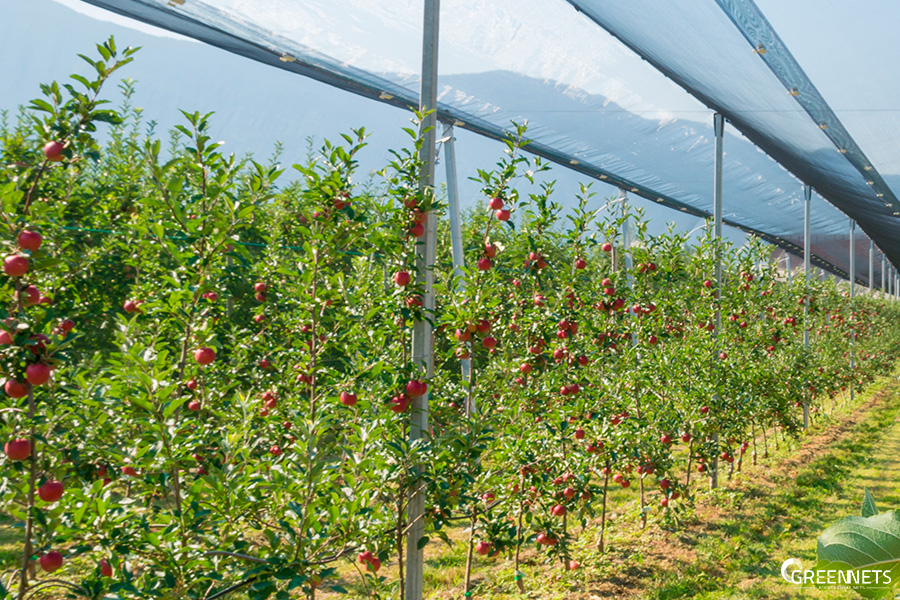
Apple
Black and grey netting colours did not improve quality and yield.
Light dispersing netting colours increased fruit size and yield. The decreasing order of these results, according to the netting colour, was: pearl, red, white, black and grey.
Pepper
The red, pearl and yellow netting colours showed a 15-40% higher yield than with black netting; they also improved fruit and post-harvest quality and reduced the incidence of diseases. The decreasing order of yields according to mesh colour was: red, pearl, yellow.
Source: Photo selective Netting for improving the performance of agricultural crops. Yosepha Shahak, Institute of Plant Sciences ARO, The Volcani Center, Bet-Dagan, Israel.