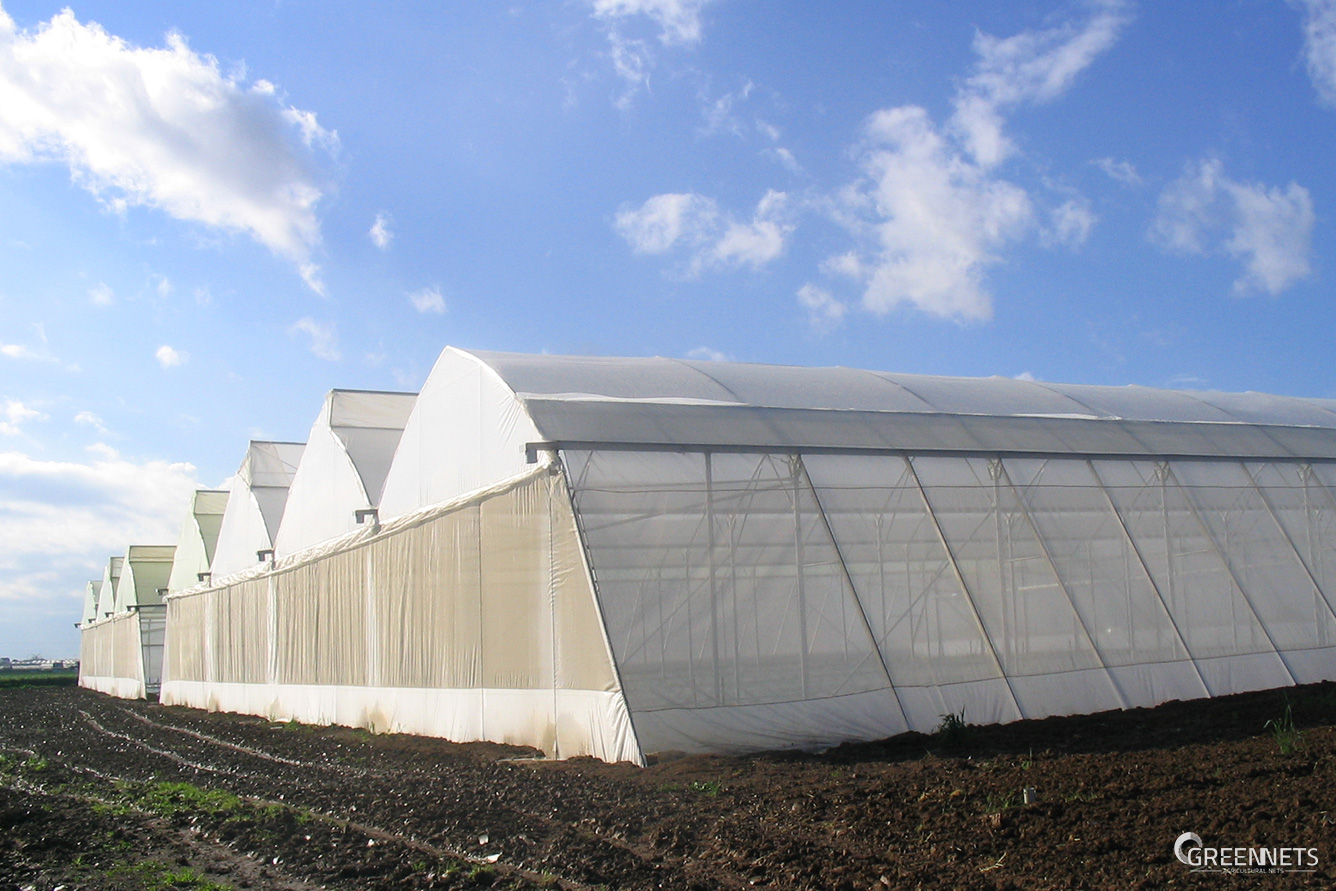
In response to the demand for quality and food safety, there was a change of strategy in the control of pests and diseases, promoting and prioritizing biological control over chemical control.
All these circumstances make insect barrier netting a primary weapon in the fight against insect pests and those acting as virus vectors: the latter have become a problem with great economic impact in protected horticulture.
As a result of this demand, BioNet® was born. The netting, developed and patented in Israel by the company MeteorNets (currently GreenNets), improves the efficiency of insect barriers nets. They combine the mechanical properties of conventional netting with new optical properties, thus increasing their blocking capacity even further.
BioNet® is made of high tensile strength, UV-stabilised, lightweight round HDPE monofilaments with a yarn density of 10×20 yarns/cm2.
They have a double insect exclusion mechanism based on their properties:
- PHYSICAL: Thanks to its high yarn density (10×20), it acts as a barrier and prevents the insects to pass through.
- OPTICAL: By absorbing UV radiation in the UV-A and UV-B range (UV-A: 400 to 315 nm; UV-B: 315-280 nm), it alters insects’ vision, which become disorientated, thus reducing their ability to attack plants.
Numerous investigations have been carried out in different parts of the world: they approve its efficiency against whitefly, leafminers, mites and thrips, among other insects.
Andalusia Regional Government laws establish the compulsory use of a minimum netting density of 20×10 yarns/cm2 in all ventilation areas, in order to avoid viral diseases transmitted by insects.