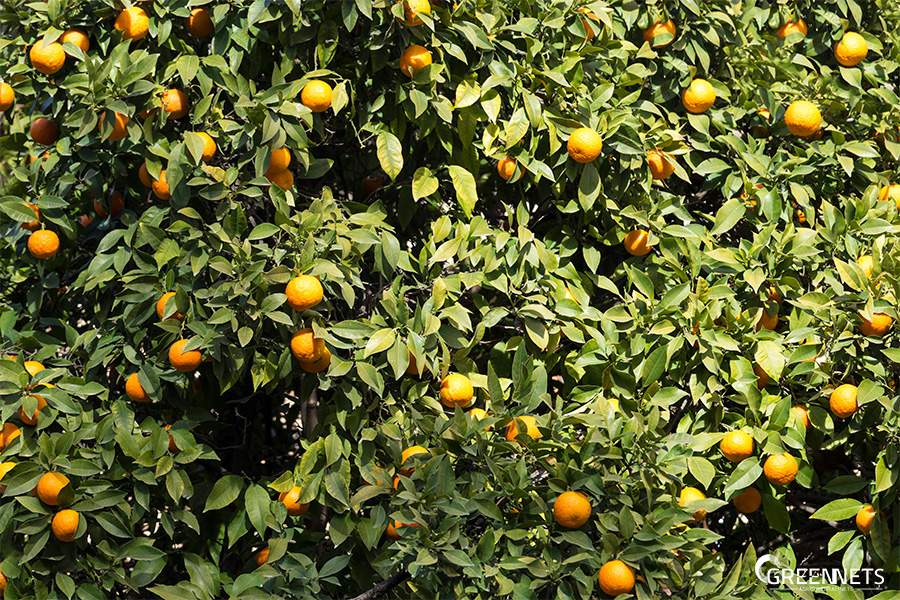
HLB (Huanglongbing) or citrus greening is regarded as the primary citrus disease in terms of economic damage worldwide. It is the most important, serious and destructive disease and is present in the citrus-growing areas of the African, American and Asian continents.
It is caused by three species of bacteria:
- Candidatus Liberibacter asiaticus (from Asia and found in Asia, America and two African countries Kenya and Ethiopia)
- Candidatus Liberibacter africanus (from Africa and only present in Africa)
- Candidatus Liberibacter americanus (from America and only present in America).
Candidatus Liberibacter asiaticus is the most aggressive species with the highest economic incidence in citrus-growing regions of the world, while Candidatus Liberibacter africanus is much less aggressive.
Neither of them has been detected in the Iberian Peninsula, nor in the Canary Islands or Madeira.
These bacteria are mainly transmitted by two insect vectors:
- Trioza erytreae – African citrus psyllid
- Diaphorina citri – Asian citrus psyllid.
Diaphorina citri, can be much more harmful than Trioza erytreae, because it adapts better to the Mediterranean climate, can live in a wider range of temperatures, is more difficult to detect and transmits the most lethal bacterium (the Asian species) causing HLB, even though it has been experimentally demonstrated that Trioza erytreae is capable of transmitting all forms of HLB.
Only Trioza erytreae was detected in the northwest of the Iberian Peninsula. Diaphorina citri has not been detected in Europe and Mediterranean countries.
Symptomatology
This disease affects the plant’s vascular system and causes the death of citrus trees.
If no action is taken, the tree dies within 5-10 years. There is currently no cure.
First symptoms:
- Shoots: yellow
- Leaves: scattered spotting and asymmetrical chlorosis (which differs from chlorosis due to deficiency, which is symmetrical), galls, and distortions.
More advanced stages of the disease
- Tree: drying and death of twigs.
- Fruit: abnormal fruit colouring (reversal of colour at maturity), production decreases drastically.
Description of insect vectors
Trioza erytreae (African citrus psyllid)
- Small (3-4 mm), aphid-sized insect.
- Winged adults, mobile and active when disturbed.
- Clear wings, unlike the Asian psyllid.
- Yellow-orange, droplet-shaped eggs on tender shoots.
- Nymphs are yellow, surrounded by short waxy excretions, and lie on the underside of tender leaves.
- They produce very characteristic bumps on the leaves and excrete large quantities of honeydew on which black mould usually develops.
Diaphorina citri (Asian citrus psyllid)
- Adults are similar in size to the African psyllid, but their wings are dark and characteristically spotted.
- When feeding, they position themselves at an angle of 45° to the leaf surface.
- They also lay on tender shoots and are similar to those of the African psyllid.
- Nymphs turn yellow in the early stages to greenish-yellow in the later stages and have no waxy secretions.
- It doesn’t produce bumps and excretes solid honeydew characteristic of this species.
Distribution in Spain
In Spain the first outbreaks of T. erytreae were detected in the Canary Islands (2002): Tenerife, La Palma and La Gomera, nowadays it is present in all the islands of the archipelago except Fuerteventura, La Graciosa and Lanzarote.
In mainland Spain it is found in Galicia, mostly in the provinces of Pontevedra and La Coruña, and in restricted areas of Lugo and Orense. Recently, its distribution has expanded throughout the Cantabrian coast, being reported in outbreaks in the Autonomous Communities of Asturias, Cantabria and the Basque Country.
After the arrival of the African citrus psyllid in the Canary Islands and the northwest of the Iberian Peninsula, vector DETECTION, CONTROL and ERADICATION are essential to prevent this disease.
The vector’s direct damage should help early detection, avoiding the serious indirect damage that would be caused by the transmission of the Candidatus Liberibacter africanus bacterium (African form of HLB), as there are currently no curative methods or species or varieties resistant to the vascular bacterium that causes the death of the affected plant.
Therefore, it is necessary to involve EVERYONE in its control, not only the agricultural sector, but also citizens in general, whether they have citrus trees in their gardens (in other countries the first outbreaks of both insect vectors and the disease have occurred in private gardens) or not, because the arrival of contaminated plant material and fruit can spread the disease. It is therefore important not to move plant material from psyllid-affected areas in northern Spain, the Canary Islands and northern Portugal to other citrus-growing areas.
In accordance with Royal Decree 949/2021 of 2 November (BOE 263 of 3 November 2021), the regulatory bases for the granting of subsidies for investments in biosafety in nurseries are established.
Eligible investments include:
Installation or retrofitting of structure and netting at MVR production sites and installation of mesh netting at belt and ridge openings and side and overhead ventilation to protect against the introduction of insect vectors of quarantine pests.
At GreenNets, we want to boost the protection of our citriculture with our specialised netting. To this end, we have two different product lines in the insect barrier category (densities of 20×10 and 16×10 threads/cm2):
- Standard insect barrier netting: made of HDPE monofilaments, with UV protection and a 5-year guarantee. Available in grey, black and clear colours, which offer different shading percentages, the choice depends on the climatic conditions and the agronomic objective.
- Our exclusive patented Bionet® photo-selective netting: made of HDPE monofilaments, with exclusive optical additives, and against UV radiation, with a 5-year guarantee. Available in white and clear colours. It has a double action mechanism: physical (acting as a barrier that prevents insects from entering) and optical (it absorbs part of the UV radiation, so that insects are disorientated and do not feed or reproduce), thus enhancing its insect barrier effectiveness. Learn more here.